
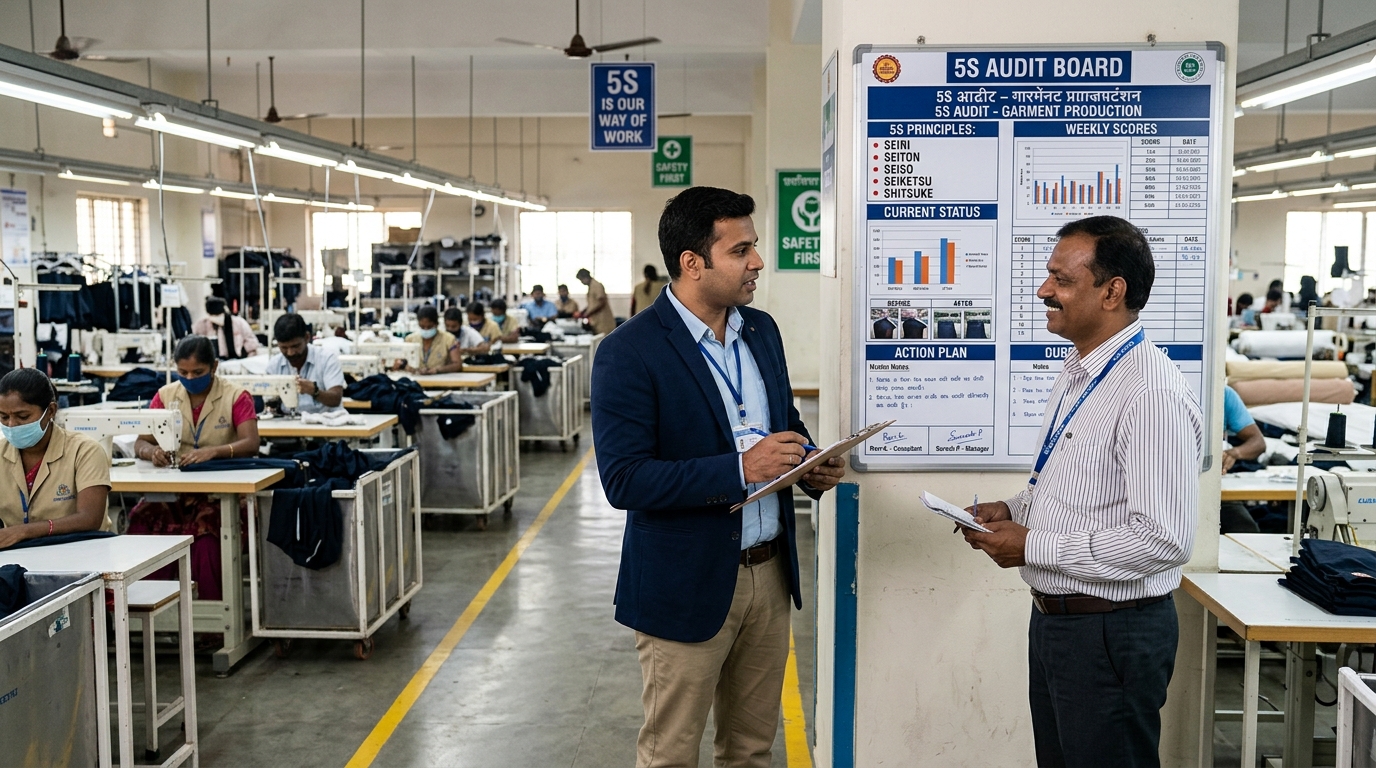
Build the operating foundation first
A smart factory needs a sound production system. Four foundations determine whether technology can deliver its intended value:
- Optimised layout and balanced throughput: Material should move through the factory with minimal handling, waiting and backtracking. Capacities across cutting, sewing, finishing and packing must support the planned output.
- Standardised processes: Clear operating methods should cover the complete production cycle and meet organisational and customer requirements.
- Continuous learning: Operators, supervisors and managers need the skills to use digital tools and sustain new ways of working.
- Workplace discipline: An organised workplace, clear responsibilities and a culture of continuous improvement support reliable execution.
Digitising an unbalanced process makes the imbalance more visible. Correcting it requires changes to flow, capacity or operating methods.
Improve the flow from fabric receipt to shipment
Material handling deserves attention early in the transformation.
Unnecessary transfers, repeated loading and unloading, poorly positioned storage and large work-in-progress inventories consume time and space. Movement between floors can add further complexity.
The first step is to map the complete material journey and remove avoidable movement. The next is to design handling methods around the product. Knits, denim and shirting have different storage and handling requirements.
Conveyors, chutes, dumbwaiters, hanger systems or automated vehicles can then support the redesigned flow. Their role should be clear: reduce handling effort, protect product quality or replenish production reliably.
A finishing backlog is a useful warning signal. When sewing output accumulates before finishing, management needs to examine finishing capacity, quality holds, batch sizes and release practices. Increasing upstream production before resolving the constraint can increase WIP without improving dispatch.
Use real-time data to support timely decisions
A Manufacturing Execution System (MES) can give teams visibility into production, quality and WIP while work is in progress.
The value comes from the response that follows. Supervisors should be able to identify an emerging bottleneck, locate delayed work and act on quality problems before they affect a larger quantity.
This requires dependable data capture at source, clear escalation rules and ownership of corrective action. Integration with planning and enterprise systems helps teams work from consistent information.
A useful test for any dashboard is: what decision will this information help someone make today?
Connect the cutting process
Cutting performance depends on the relationship between planning, fabric preparation, spreading, cutting and reconciliation.
An integrated approach connects pattern and marker preparation with roll information, fabric relaxation, spreading plans and cut-panel inspection. It helps teams understand fabric consumption and identify losses across the process.
Factories should assess smart cutting against measurable outcomes such as fabric utilisation, output, manpower requirements and traceability. Savings targets must reflect the factory’s current baseline, product mix and implementation scope.
Select automation around the operation
Automation can reduce skill dependency and improve consistency where operations are repetitive or difficult to staff.
However, machine speed alone is an incomplete basis for investment. The assessment should include loading and unloading, operator involvement, changeover time, quality performance and the capacity of the next process.
Low-cost work aids, profiles and attachments may offer worthwhile improvements alongside specialised equipment. The scope should also extend to finishing and packing, where constraints can limit the benefit of sewing automation.
For each investment, define the expected result before purchase and verify it under normal production conditions.
Strengthen industrial engineering and quality
Digital industrial engineering tools can support workload balancing, skill deployment and changeover management. Their effectiveness depends on accurate work standards and regular use by the production team.
Digital quality systems can help teams identify defect trends, monitor inspection results and track corrective actions. Capturing a defect is only the beginning. The system should help determine its cause, assign responsibility and verify that the correction works.
Together, these capabilities support a more consistent way of managing the factory across shifts and supervisors.
Extend the transformation beyond production
Production performance also depends on planning, maintenance, utilities and workforce readiness.
Maintenance and TPM help keep automated equipment available. Utility monitoring can reveal consumption patterns that affect operating cost. Planning tools can align order priorities with material readiness and available capacity.
Workforce analytics may support training and retention decisions. AI applications should follow where reliable data and a clear use case justify them.
Management needs a common view of these functions, with named owners responsible for reviewing performance and acting on deviations.
Make the roadmap measurable
A practical smart factory roadmap begins with a baseline assessment. It should establish current throughput, WIP, lead time, quality losses, manpower deployment and relevant operating costs.
The next step is a focused pilot addressing a defined constraint. Results should be measured against the baseline before wider deployment.
The financial evaluation should include implementation, integration, training, maintenance and recurring software costs. Operational measures should confirm whether the change improves the complete factory’s performance.
The strongest investment case connects a specific intervention to a verified business result.
Cent Edge’s approach
Cent Edge Consulting brings together factory layout, industrial engineering, material handling, automation and digital systems to develop practical transformation roadmaps for apparel manufacturers.
Our approach starts with the production system and its constraints. We then identify suitable interventions, support implementation and establish the measures needed to assess performance.
Planning a new factory or upgrading an existing operation? Connect with Cent Edge for a dipstick study and a phased Smart Factory roadmap aligned with your business priorities.
Cent Edge Consulting Pvt Ltd
Smart Factory | Manufacturing Excellence | Profitable Results